
Outdoor kitchen in salt air.
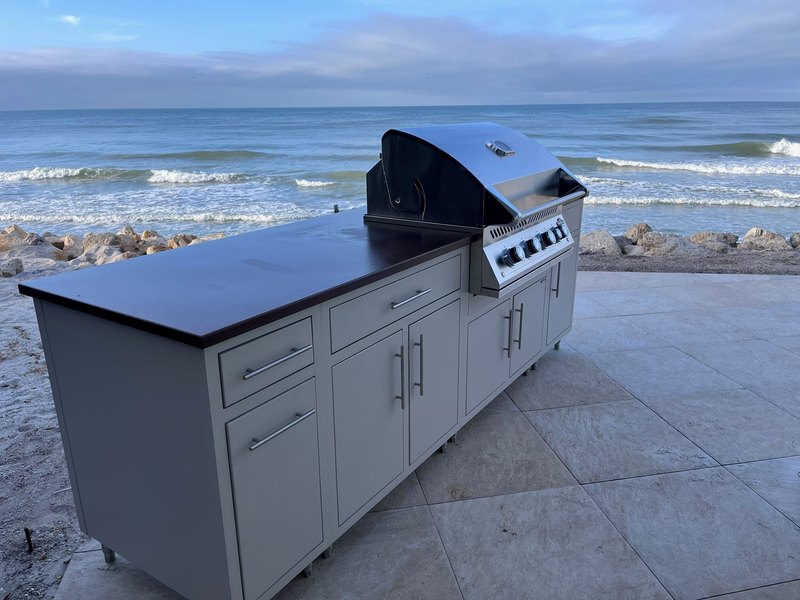
An outdoor kitchen in salt air near Sarasota faces salt and humidity on grill surfaces and hardware. Stainless steel grade affects how parts handle that exposure, but no grade is immune to corrosion. Rinse exposed surfaces, keep equipment dry, and follow each grill's manual. Check the model and part before comparing grades.
What holds up in an outdoor kitchen on Sarasota's barrier islands and what corrodes?
Stainless steel grade affects how a grill part handles salt, but no grade is immune to corrosion. Outokumpu recommends different grades for light marine and coastal settings. Rinse salt from exposed surfaces, keep equipment dry, and follow the manual for each model. Check the model and the part before comparing grades.
Outokumpu's stainless steel guidance, checked October 10, 2026, says chlorides drive atmospheric corrosion of stainless steel and that corrosion performance increases with molybdenum. Its corrosion-zone table lists more highly alloyed steels, such as Forta DX 2205 and Ultra 904L, for coastal and industrial marine zones. So 316 is a starting point near salt water, not a ceiling. It is not a promise that any stainless surface can be ignored.
| 304 | Common outdoor grill grade, good resistance with cleaning |
|---|---|
| 316 | Molybdenum-bearing grade with better chloride pitting resistance |
| Risk to watch | Salt residue left wet on seams, edges, and hardware |
Published stainless grades vary by grill brand
Twin Eagles' C Series page, checked October 10, 2026, lists 304 stainless steel construction and 14-gauge 304 stainless steel burners. Delta Heat's Dometic product page, checked the same day, lists 304 stainless steel with welded construction. Lynx's Sedona L600 page, checked the same day, lists stainless steel burners and grates but does not name their grade.
A product page that does not name a grade leaves that detail open. Check the exact model and part in its manual. Burners, grates, doors, fasteners, and cabinet frames can use different materials.
Tea staining on stainless steel
Tea staining is discoloration of the stainless surface caused by corrosion. The Australian Stainless Steel Development Association, checked October 10, 2026, calls it a cosmetic issue that does not affect the structural integrity or lifetime of the material. It occurs most commonly within about five kilometers of the surf. Wind exposure, local sheltering, and higher temperatures can produce it 20 kilometers or more from the surf.
ASSDA recommends washing with soap or mild detergent and warm water, rinsing with clean water, and wiping the surface dry. This cleaning guidance is for stainless steel surfaces.
Cabinet frames and exteriors in humidity
Our standard outdoor kitchen frame is aluminum with a Hardie board exterior. The frame and exterior still need proper flashing, drainage, joints, and finish details chosen for the actual site.
Pinecraft also offers composite cabinetry in woodgrain or solid colors. Wood can swell, move, or rot when water stays trapped. Untreated mild steel can rust when salt and moisture reach the surface or a coating is damaged.
Cover and care for outdoor cookers
Big Green Egg's European maintenance page, checked October 10, 2026, says the ceramic can stay outdoors in all weather and recommends covering the Egg when it is not in use to protect metal parts. It also recommends spraying the hinge and draft door with WD-40 or silicone spray a few times a year. For a rEGGulator, it says to cover the Egg after use once it has cooled.
Big Green Egg's US safety guide, checked the same day, recommends a heavy-duty, ventilated cover and a wind-sheltered spot to limit snow, ice, and moisture buildup. It also recommends periodic checks of nuts, bolts, and band hardware for tightness and alignment.
Meadow Creek's BBQ26S product page, checked October 10, 2026, says its rotating double-sided grates are food-grade T304 stainless steel rod, and that the grill body is 13-gauge welded steel painted with black heat-resistant paint. The body is painted, not stainless. The product page lists a vinyl cover as an option.
The Twin Eagles C Series manual (PDF) and the Delta Heat manual (PDF), checked the same day, warn against dented or rusted LP cylinders and cylinders with damaged valves. Both warn against storing a spare cylinder under or near the appliance.
Pellet storage and rain exposure
Green Mountain Grills' Daniel Boone support page, checked October 10, 2026, recommends clean, dry indoor storage for pellets in their original bags or a waterproof storage container. It does not recommend using its grills in the rain because of their electrical components.
The Pinecraft catalog page lists cover 61500 for Prestige PRO 500 and Prestige 500 gas grills. See the Napoleon grill cover page.
Questions to ask before you choose a model
Ask for the exact stainless grade and which parts it covers. Ask where rinse water drains, what the cover protects, and whether air can move under it. Check where the propane cylinder sits and how the cabinet vents. Bring a photo of the wall, pool deck, or lanai edge.
The model name and your cooking needs help narrow the options. Confirm the model at the showroom, then request a quote. See outdoor kitchens, read about grill inserts, or call (941) 217-6995.
Project requirements and manuals
Sarasota County or Manatee County decides the applicable permit and local requirements. The HOA decides its own review, setback, and appearance rules. The manufacturer's manual lists the appliance clearances.
Pinecraft designs outdoor kitchens and supplies the equipment. Pinecraft provides the installers and supports manufacturer warranties. See the service area, or visit the showroom at 3303 Bahia Vista St, Sarasota, FL 34239. Contact details are on the contact page.
Source notes
The stainless guidance comes from Outokumpu. The tea staining and cleaning guidance comes from ASSDA. Manufacturer specifications and care instructions are linked in the relevant sections. Each linked source was checked on October 10, 2026.